I figured it was time for me to put my Wingscapes Birdcam to good use again. And with the arrival of some of our exciting and colorful summer residents, it seemed like the perfect opportunity to see just who visits our hummingbird feeders while we're not at home.
I tried two seperate locations to play around with lighting and angles. This first movie, compiled from clips spanning from 6:18am to around 4:15pm yesterday, was at the feeders' normal location, hanging from the eaves of the house near our dining room window:
For this second movie, compiled from today's clips, I moved the most popular feeder to the clothesline in our backyard to try to take advantage of the more direct sunlight. I'd never keep the feeder out there during the height of summer, so this was my opportunity during the cooler spring to try it out. It took much longer for the birds to find it, with the first hummer not arriving until 7:08am. Eventually, everyone did find it, but considerably less activity. Yesterday the cam captured 505 10-second clips while today's location only captured 137.
I particularly liked the unexpected visitor at 0:22, and the look on the Black-chinned Hummingbird's face when he looks back at the camera at the one-minute mark. Priceless!
Showing posts with label wingscapes. Show all posts
Showing posts with label wingscapes. Show all posts
April 12, 2008


February 10, 2008
More Bluebirds
 I went on a bird hike this morning here at the Well sponsored by Northern Arizona Audubon. I wasn't planning to, but Sonja needed to study for two exams she has this week, so I thought it might be less distracting if I wasn't in the house making noise. We didn't see much that we weren't expecting, although we did have a Bald Eagle fly over at one point. Here are a couple more Western Bluebird pictures. They're always cooperative and photogenic.
 We did get some great views of a Sora forgaging around the edge of the water below us. Unfortunately, my camera doesn't do very well taking pictures of Robin-sized birds from 150 yards away. You can sort of tell it's a Sora, at least. I set up the BirdCam along the water's edge this morning with the hopes of getting some video of some of the waterfowl, and particularly the Sora. But for some reason the motion sensor never went off. The only videos I got were of me breaking our tripod as I was getting it unstuck this evening when I went to go fetch it. I'll have to figure out what I did wrong and try again some other time.
February 08, 2008
BirdCam
I finally got around to getting a memory stick for my BirdCam from Wingscapes. Without a stick the cam can only record about five short videos. And that only takes about a half hour. But, with a 2 Gig memory card the BirdCam was able to capture almost 200 videos spanning the entire day today.
I focused it on the suet hanging from our platform feeder to see who would show up. Here's a collection of the best clips from today.
Ten points to anyone who can identify all of the birds in the video. An extra five points for anyone that can ID them to specific forms or subspecies (when applicable). I was really surprised by one of the birds it caught hanging off of the feeder. I totally didn't expect to see one of those doing that. It was very uncharacteristic of the species.
I spent most of the day working out at Tuzigoot National Monument today. That usually means getting a chance to find some birds I don't typically get to see over here on the east end of the Verde Valley. Namely the Verdins.
 For some reason the autofocus decided to act all funky on me. So I switched to manual, but trying to find the focus point on a bird that refuses to sit still is a bit of a challenge. Which is why this picture isn't very sharp. Oh well...
I focused it on the suet hanging from our platform feeder to see who would show up. Here's a collection of the best clips from today.
Ten points to anyone who can identify all of the birds in the video. An extra five points for anyone that can ID them to specific forms or subspecies (when applicable). I was really surprised by one of the birds it caught hanging off of the feeder. I totally didn't expect to see one of those doing that. It was very uncharacteristic of the species.
I spent most of the day working out at Tuzigoot National Monument today. That usually means getting a chance to find some birds I don't typically get to see over here on the east end of the Verde Valley. Namely the Verdins.
 For some reason the autofocus decided to act all funky on me. So I switched to manual, but trying to find the focus point on a bird that refuses to sit still is a bit of a challenge. Which is why this picture isn't very sharp. Oh well...
October 27, 2007
Birdcam Time-lapse
Our birdcam from Wingscapes took 73 images today. That's about all it will hold until I get a memory card for it. But, it took 5 hours to capture all those pictures using the settings I chose. Rather than having to choose only a couple of these pictures to post on here, I decided to show them all to you. So I turned them into an animated "gif" that gives you an idea of what it's like to spend five hours sitting on the ground next to our house. The file is 8 megs, so be patient while it loads (I think you have to click on the picture in order to see the animation).
 I counted three species enjoying the sunflower seeds this morning: House Finches, White-crowned Sparrows, and a Dark-eyed Junco (bonus points for anyone who can identify the subspecies of junco). Figures that five minutes after I pick up the camera three doves decide to walk right in front of where it was sitting.
 I counted three species enjoying the sunflower seeds this morning: House Finches, White-crowned Sparrows, and a Dark-eyed Junco (bonus points for anyone who can identify the subspecies of junco). Figures that five minutes after I pick up the camera three doves decide to walk right in front of where it was sitting.
October 12, 2007
Another New Toy
Last week I got an email that I was a little suspicious about. It was an offer to send me, a blogger who tends to highlight nature photography, a "birdcam". Naturally, I was dubious at first, but I looked into it a bit. Seems there is a company out there called Wingscapes that makes these motion-sensing cameras that you can mount on bird feeders, bird houses, trees, pretty much anything you want. So I figured, what the hell.
Well, guess what arrived on my front step a few days ago?
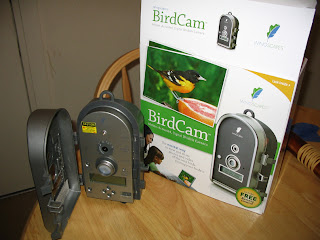 Ain't it purty? I'm pretty psyched about this thing. It's a new toy I've pondered about for a while. I was so excited I ran to get batteries for the thing and try it out. Since we haven't had much activity at our feeders for a while I decided I wanted to try it along the path where we've been spotting the mountain lion tracks. So I went out around sundown to go set it up, knowing that the sensor wouldn't turn on until sunrise, but hoping that it might catch something walking by in the early morning light. Well, the results weren't quite as exciting as I'd hoped (but not for lack of how cool this thing is).
 Here is my first official birdcam picture...of my knee. I guess there wasn't much activity that morning. I need to figure out how to set the date, too. I suppose reading the manual might help, eh? Anyway, I haven't had time to play with it since then, so I'm waiting until Sunday to really start putzing with it. It's even got a setting to capture video. Now I just have to find a good place to set it up to capture some daytime critters. You can expect more from the birdcam in the days and weeks to come.
I'm still playing around with our camera, too. Here are some recent pictures from around the Well.
 Figuring out the intricacies of focusing while in the macro mode is a bit of a challenge. The depth of field (how big or small the in-focus area is) seems to get in my way a lot, as you can tell with this image of an immature greater earless lizard. I wanted to get its eye into focus, but since I was so close, and its head was turned slightly toward me, that meant its nose got all blurry. I need to figure out if there's a way to fix that. There probably is. I still like the picture though. Makes this tiny little lizard (it was perhaps 2.5 inches long, from nose-tip to tail-tip) look unnaturally large. At least I got the exposure sort of right.
I'm going to start posting the settings I used to take each picture with the hopes that someone with more SLR experience than myself can give me pointers for taking better photographs. So, if you're not interested in all these numbers, you can skip ahead. For all of these pictures I put the camera on the Tv setting, so it's deciding the aperature for each shot (1/250, f5.6, ISO 200 with the Sigma 70-300mm).
 This little Rock Wren was sitting at the perfect spot for the setting sun to illuminate its head. I've noticed that when I zoom all the way in using this lens, my pictures seem a little soft. I don't know if this is a result of buying the cheapest 300mm lens I could find, or something I'm just not doing right when I take the picture. I'm wondering if I just need a better eye for getting the focus right. But if you click on the image, then you'll see what I mean. It's just a little on the fuzzy side. (1/160, f5.6, ISO 200 with the Sigma 70-300mm, focal length 300mm)
 With the departure of nearly all of our summer migrants, the winter residents have begun to appear in the neighborhood, including this female White-crowned Sparrow, one of the first of the season. See, this one is much crisper, but she's also in full sunlight, while the Rock Wren (and the American Dipper from the previous post) was in shadow. I'm thinking now that it might be a result of camera shake considering the slow shudder speed I used for the wren. (1/1000, f5.6, ISO 200 with the Sigma 70-300mm, focal length 300 mm)
 Finally, a picture of the morning light playing with a spider web. This one is my favorite of the bunch. (1/320, f5.6, ISO 200 with the Sigma 70-300mm, focal length 238mm)
Well, guess what arrived on my front step a few days ago?
 Ain't it purty? I'm pretty psyched about this thing. It's a new toy I've pondered about for a while. I was so excited I ran to get batteries for the thing and try it out. Since we haven't had much activity at our feeders for a while I decided I wanted to try it along the path where we've been spotting the mountain lion tracks. So I went out around sundown to go set it up, knowing that the sensor wouldn't turn on until sunrise, but hoping that it might catch something walking by in the early morning light. Well, the results weren't quite as exciting as I'd hoped (but not for lack of how cool this thing is).
 Here is my first official birdcam picture...of my knee. I guess there wasn't much activity that morning. I need to figure out how to set the date, too. I suppose reading the manual might help, eh? Anyway, I haven't had time to play with it since then, so I'm waiting until Sunday to really start putzing with it. It's even got a setting to capture video. Now I just have to find a good place to set it up to capture some daytime critters. You can expect more from the birdcam in the days and weeks to come.
I'm still playing around with our camera, too. Here are some recent pictures from around the Well.
 Figuring out the intricacies of focusing while in the macro mode is a bit of a challenge. The depth of field (how big or small the in-focus area is) seems to get in my way a lot, as you can tell with this image of an immature greater earless lizard. I wanted to get its eye into focus, but since I was so close, and its head was turned slightly toward me, that meant its nose got all blurry. I need to figure out if there's a way to fix that. There probably is. I still like the picture though. Makes this tiny little lizard (it was perhaps 2.5 inches long, from nose-tip to tail-tip) look unnaturally large. At least I got the exposure sort of right.
I'm going to start posting the settings I used to take each picture with the hopes that someone with more SLR experience than myself can give me pointers for taking better photographs. So, if you're not interested in all these numbers, you can skip ahead. For all of these pictures I put the camera on the Tv setting, so it's deciding the aperature for each shot (1/250, f5.6, ISO 200 with the Sigma 70-300mm).
 This little Rock Wren was sitting at the perfect spot for the setting sun to illuminate its head. I've noticed that when I zoom all the way in using this lens, my pictures seem a little soft. I don't know if this is a result of buying the cheapest 300mm lens I could find, or something I'm just not doing right when I take the picture. I'm wondering if I just need a better eye for getting the focus right. But if you click on the image, then you'll see what I mean. It's just a little on the fuzzy side. (1/160, f5.6, ISO 200 with the Sigma 70-300mm, focal length 300mm)
 With the departure of nearly all of our summer migrants, the winter residents have begun to appear in the neighborhood, including this female White-crowned Sparrow, one of the first of the season. See, this one is much crisper, but she's also in full sunlight, while the Rock Wren (and the American Dipper from the previous post) was in shadow. I'm thinking now that it might be a result of camera shake considering the slow shudder speed I used for the wren. (1/1000, f5.6, ISO 200 with the Sigma 70-300mm, focal length 300 mm)
 Finally, a picture of the morning light playing with a spider web. This one is my favorite of the bunch. (1/320, f5.6, ISO 200 with the Sigma 70-300mm, focal length 238mm)
Subscribe to:
Posts (Atom)