While there are seven recognized "forms" of the Dark-eyed Junco in North America, most people are generally familiar with only the one or two that visit their winter feeders. In Fairbanks, for instance, we only saw "slate-colored" forms. Now that we are in Arizona, however, things have gotten much more interesting. Today I identified four distinct forms of Dark-eyed Juncos in our yard. I got photos of three of them today and am using an older picture I took of the fourth for comparison.
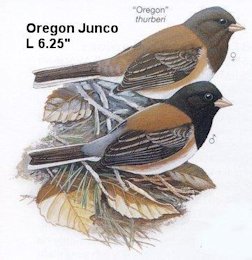
 Here is the "Oregon" form. Due to how dark this bird's head is we can even identify it as a male. These forms tend to have the greatest contrast in their plumage, with very dark heads and much lighter bellies and backs.
 I've identified this one as a "pink-sided" junco. Now, out of all four of my identifications, this is the one I'm least confident about. Not to say I don't still think it's a pink-sided, just that there is a twinge of uncertainty remaining. Now, I chose pink-sided primarily due to how extensive the buffy coloring is on the breast. In oregon forms, you should be able to see some white near the top of the breast. That said, it's head is still a bit on the dark side, so there is a chance it could be a first year female oregon. But for the purposes of this blog post, it's a pink-sided. So there.
 The grey-headed form is almost as common around here as the Oregon, but for some reason we haven't been seeing as many lately. There were only two that I spotted this afternoon. I took the photo of this grey-headed junco near Flagstaff last October, actually. Take special note of the color of the bill on this bird, then continue to the next picture.
 Now, when I first saw this bird today my first reaction was grey-headed. Then I took a closer look at the bill. Can you see how the upper half is much darker than the lower half? That makes this bird a "red-backed" junco. For most non-birders, this distinction doesn't really mean that much, and it might still be kind of hard to see. So here are the two birds side-by-side:
 Really, the only difference between these two forms is the darker upper bill on the red-backed. And when you see them next to each other like this, it's pretty obvious.
So, there you have it. Four different junco forms in one yard in a single afternoon. Now, to me this is all incredibly interesting. But I suppose that's the reason our license plate says "BRDNERD". So, for those of you who don't find the many forms of juncos fascinating enough to dedicate an entire blog post to them, here's a special treat just for you.
 You're very own Abert's Towhee! For how big this bird is (nearly robin-sized) they're rather spineless. The juncos spent the better part of the afternoon pushing this one around, bullying it off of the platform feeder.
Anyway, now you know more about juncos.